
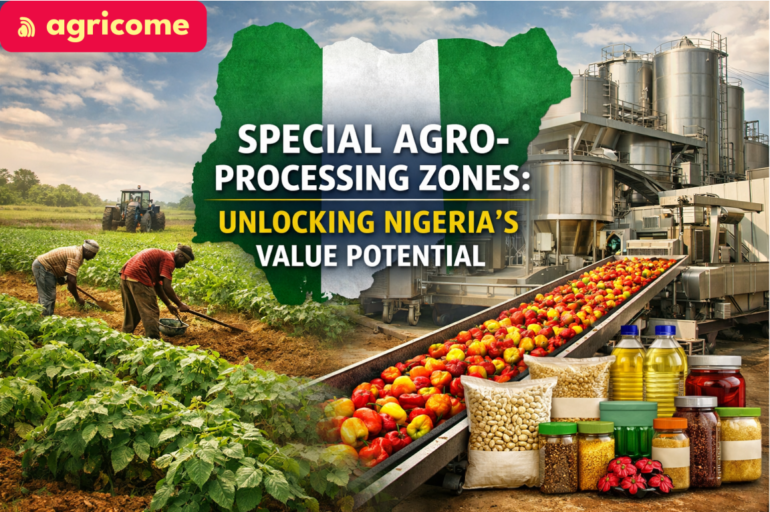
Nigeria’s agricultural sector employs millions and contributes significantly to the country’s GDP, yet much of its output leaves the country as raw commodities with minimal value addition. The result is a persistent gap between production potential and economic returns. As international markets increasingly reward processed, traceable, and standards-compliant products, the urgency for structural transformation in Nigeria’s agribusiness landscape has never been greater.
Special Agro-Processing Zones (SAPZs) present a strategic pathway to improve value capture. These are designated zones designed to cluster agro-industrial activities close to production hubs. They integrate reliable infrastructure, processing and manufacturing facilities, logistics, export support systems, and policy incentives such as tax reliefs and streamlined regulatory processes.
WHY SAPZs MATTER FOR NIGERIA
1. Value addition at scale: Nigeria produces large volumes of crops like sesame, soybeans, hibiscus, cashew, and ginger, yet much of the economic value is captured abroad where processing occurs. SAPZs enable local transformation into higher-value products, increasing export earnings and reducing dependence on raw commodity markets.
2. Reduced post-harvest losses: Post-harvest losses remain a major challenge due to poor storage and limited processing capacity. Processing clusters within SAPZs provide immediate off-take and preservation, reducing waste and improving quality.
3. Export competitiveness: International buyers demand consistency, traceability, and compliance with quality standards. SAPZs in Nigeria, such as those in Cross River, Kaduna, and Oyo, provide agribusinesses with organized production networks.
4. Rural industrialization and jobs: By locating processing facilities to production zones, SAPZs stimulate
local economic ecosystems, creating jobs in processing, logistics, maintenance, quality control, and services.
5. Investment and technology inflow: Investors are more confident where infrastructure, policy clarity, and industrial clustering exist. SAPZs attract foreign direct investment, modern processing technologies, and technical expertise.
IMPLICATIONS FOR KEY COMMODITIES
For value chain players like Agricome, SAPZs signal a transition from commodity trading to agro-industrial value creation. Hibiscus can move beyond bulk raw export into higher-value formats such as extracts, tea blends, and standardized dried products. Sesame and cashew benefit from cleaning, hulling, roasting, and packaging processes that unlock premium market segments. Soybeans present opportunities for oil extraction, protein concentrates, and feed production, while ginger can be upgraded through powdering, oil extraction, and standardized packaging. Together, these value-addition pathways strengthen competitiveness, improve margins, and enhance export readiness.
CHALLENGES TO ADDRESS
While promising, SAPZs must overcome practical hurdles, including infrastructure delivery and maintenance, policy consistency and efficient implementation, access to finance for SMEs operating within the zones, and existing technical and managerial capacity gaps. SAPZs are more than infrastructure projects; they are economic reform tools. For stakeholders across the value chain- farmers, processors, exporters, investors, and policymakers- the zones provide a pathway to transitioning from fragmented production to coordinated, industrialized agriculture. The future of Nigerian agriculture lies not only in how much is produced, but in how much value is created before products reach international markets, and SAPZs offer a structured route to make that transition possible.